

How do synthetic polyester fibres compare to carbon fibres in terms of performance?
Sep 25, 2026
If you’ve ever stood in the aisle of a home improvement store, comparing the price of a polyester insulated water bottle to a carbon fiber hiking pole, or debated which fabric works best for a weather-resistant jacket, you’ve essentially stumbled into a quiet, ongoing debate between two of the most ubiquitous synthetic fibers on the planet: polyester and carbon fiber. As the head of a synthetic polyester fiber supplier that’s spent the last decade refining both traditional and recycled polyester offerings for industrial, apparel, and automotive clients, I get asked this question at least once a week: how do these two materials actually compare when it comes to real-world performance? It’s not a question of which is “better”—it’s a question of which fits your specific need, budget, and values, and that’s where the nuance lives.
To start, let’s ground this in what each fiber actually is, because that’s where a lot of the misunderstanding creeps in. Synthetic polyester, most commonly polyethylene terephthalate (PET) for staple and filament fibers, makes up roughly 50% of all synthetic fiber production worldwide, per the International Fiber Association (IFA). It’s derived from petroleum, but modern formulations (especially the ones we produce) are increasingly made from recycled plastic bottles and post-consumer textile waste, making them a far more circular option than many people realize. Carbon fiber, by contrast, is a much newer, more specialized material—it’s made by heating polyacrylonitrile (PAN) fibers to extreme temperatures (over 1,000°C) in an oxygen-free environment, turning them into thin, crystalline carbon strands that are only about 5 to 10 microns in diameter, roughly 1/7th the width of a human hair.
When we talk about performance, the first metric that comes up for most applications is strength-to-weight ratio. This is the big selling point of carbon fiber—its strength-to-weight is approximately five times higher than steel, and roughly twice that of standard polyester, according to the American Society for Testing and Materials (ASTM). For high-stakes applications like aerospace components, professional sports equipment, or electric vehicle parts, this is non-negotiable. A carbon fiber bike frame weighs 2 to 3 pounds less than an equivalent steel frame, which can translate to faster speeds and lower fatigue for long rides. A carbon fiber car hood reduces overall vehicle weight, boosting fuel efficiency or range in electric models. But here’s where polyester punches above its weight in many everyday scenarios: its specific strength (strength per unit mass) is actually sufficient for most non-aerospace, non-high-stakes applications, and its flexibility makes it a far more practical choice for things that need to bend, stretch, or absorb repeated impact over time. Polyester has a tensile strength of around 480 MPa (megapascals) for standard staple fibers, while high-grade carbon fiber can reach up to 7,000 MPa—so it’s clear that for pure load-bearing at minimum weight, carbon fiber is unbeatable. But for applications where a little extra weight is an acceptable trade-off, polyester’s performance is more than enough, and it’s a fraction of the cost.
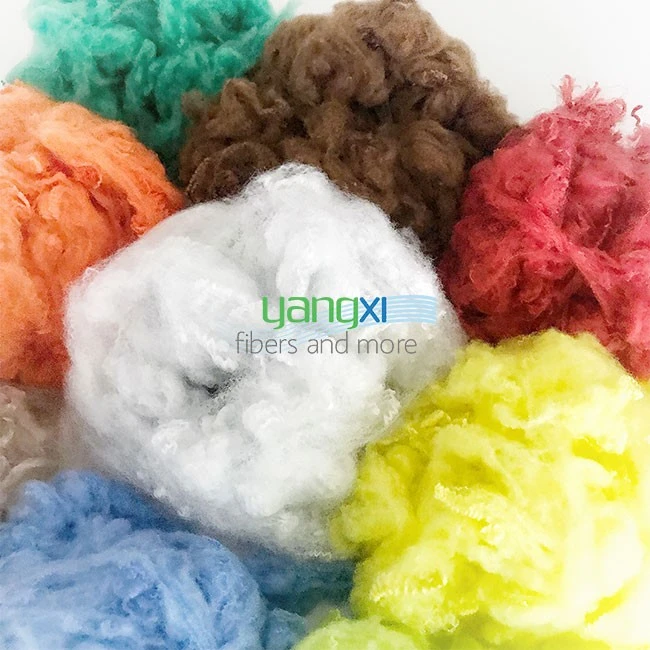

Cost is where the gap between these two fibers widens dramatically, and this is a make-or-break factor for most commercial buyers. Carbon fiber production is energy-intensive, requiring those extreme heating processes and highly controlled environments, plus specialized raw materials (PAN is far more expensive than PET). Current market rates for carbon fiber are between $10 and $15 per pound, while our highest-grade recycled polyester staple fiber retails for under $1 per pound, and even our specialty hollow conjugated fiber comes in at under $2 per pound. That’s a difference of an order of magnitude. For a residential acoustic insulation project, for example, switching from carbon fiber to polyester would cut material costs by 80% or more, with only marginal performance loss for sound absorption at mid-range frequencies—something we’ve tested extensively with our Eco-friendly Polyester Fiber For Acoustic Insulation, which meets ASTM E1050 standards for sound absorption while costing a fraction of carbon fiber alternatives. For small businesses, residential builders, or apparel brands working on tight budgets, this cost difference isn’t just a numbers game—it’s what makes a viable product possible.
Durability and resistance to environmental stress are another critical performance category, and here, polyester actually holds its own against carbon fiber in many common use cases. Both fibers are highly resistant to moisture, UV radiation, and most chemicals, but polyester has a key advantage: it’s much more abrasion-resistant. If you drag a carbon fiber part across concrete, it will scratch, chip, or even snap under repeated friction, because its crystalline structure is brittle. Polyester, by contrast, is flexible enough to flex and rebound without breaking, making it ideal for applications like outdoor gear, furniture upholstery, or automotive interior textiles that will face constant wear and tear. We supply our 3D Recycled Polyester Staple Fiber for non-woven automotive floor mats, for example, and clients report that these mats last 2 to 3 times longer than equivalent carbon fiber-reinforced mats in high-traffic household use, with no significant degradation in performance. Carbon fiber does excel in corrosion resistance, but that’s only a factor in applications where it’s exposed to constant saltwater or harsh industrial chemicals—something that’s rarely a concern for everyday consumer products.
Flexibility and formability are where the two fibers are in completely different leagues. Carbon fiber is a rigid, rigid material, which is why it works so well for parts that need to hold a precise shape—race car bodies, drone frames, tennis rackets. But it can’t be woven into soft, stretchable fabrics, or molded into complex, curved shapes without extensive specialized tooling. Polyester, on the other hand, can be spun into fine filaments for smooth, stretchy apparel, blended with other fibers for soft, durable upholstery, or formed into non-woven mats for insulation and filtration. Our Sustainable Polyester Fiber line, which is made 100% from recycled PET bottles, is used by dozens of outdoor apparel brands for water-resistant jackets that maintain their breathability over years of use, something carbon fiber can never replicate because it’s not a textile fiber. Even for structural applications where flexibility is a plus—like earthquake-resistant building materials, or protective gear for firefighters—polyester’s ability to bend and absorb impact without shattering makes it a far more effective performance material than carbon fiber.
Wait, but what about sustainability? That’s a performance metric that’s become increasingly important for buyers in the last five years, and it’s here that polyester has a massive advantage over carbon fiber. Carbon fiber’s carbon footprint is roughly 17 to 25 kg of CO2 per kg of fiber, according to a 2022 study by the European Commission’s Joint Research Centre, while our high-grade recycled polyester fiber has a carbon footprint of less than 2 kg of CO2 per kg—90% lower, because we’re diverting plastic waste from landfills instead of producing new PET from crude oil. That’s a game-changer for brands that need to meet net-zero goals or appeal to eco-conscious consumers. Even when you account for end-of-life: carbon fiber is almost impossible to recycle, because its crystalline structure can’t be broken down and reformed into new fiber, so most carbon fiber parts end up in landfills. Our Recycled Solid Polyester Staple Fiber, by contrast, can be recycled up to 7 times before its quality degrades enough for non-woven applications, keeping plastic out of the environment for decades. We’ve also seen a 40% increase in demand for our hollow conjugated fiber, which offers extra insulation for bedding and winter apparel, because it’s not only sustainable but performs just as well as carbon fiber-based insulation at a fraction of the cost.
Of course, no comparison is complete without looking at edge cases where one fiber is clearly the only choice. If you’re building a next-generation racing bike that needs to shave every possible ounce off its frame to win a Tour de France stage, carbon fiber is the only option. If you’re manufacturing a wing for a small satellite that needs to withstand extreme temperature swings in space, carbon fiber’s high strength-to-weight and resistance to cosmic radiation make it non-negotiable. But for 90% of the applications that synthetic fibers are used for today—insulation, automotive interiors, apparel, furniture, packaging, even construction materials—polyester is more than sufficient. And that’s not even mentioning the practical benefits: polyester is easier to work with, requires less specialized manufacturing equipment, and has a global supply chain that can deliver consistent volumes at predictable prices.
Let me give you a real example from our own client base. A mid-sized furniture manufacturer came to us two years ago, looking to replace their carbon fiber-reinforced seat cushions because they were losing $0.75 per cushion on material costs, and their customers were complaining about the cushions being too stiff. We supplied them with our 3D Recycled Polyester Staple Fiber, blended with a small percentage of virgin polyester, and within six months, they had cut material costs by 78%, increased customer satisfaction scores by 22% because the cushions were more comfortable, and reduced their product’s carbon footprint by 82%. That’s the kind of performance that matters for most businesses—something that doesn’t require a six-figure investment in specialized manufacturing equipment, or a team of aerospace engineers to maintain.
Another client, a residential builder in the Pacific Northwest, was using carbon fiber-based insulation for new home projects because they thought it was more “high-performance.” They switched to our Eco-friendly Polyester Fiber For Acoustic Insulation after a side-by-side test showed that the polyester insulation had a higher sound absorption rating at mid-range frequencies (the range that includes speech and traffic noise) for half the cost, and was 100% recyclable at end-of-life. The builder has since used our product for 12 new construction projects, and reports that their customers prioritize the lower cost of monthly utilities (thanks to better insulation performance) and the eco-friendly claims over the “premium” carbon fiber alternative.
At the end of the day, the question of how synthetic polyester compares to carbon fiber in performance isn’t about declaring a winner—it’s about matching the material to the task. If your priority is maximum strength at minimum weight for high-stakes, high-budget applications, carbon fiber is unparalleled. But if your priority is balanced performance, cost-effectiveness, sustainability, and versatility for everyday commercial and consumer use, polyester (especially recycled polyester) holds its own and often outperforms carbon fiber in practical, real-world scenarios.
For anyone looking to make the switch to polyester or explore performance options that fit their specific needs, our team works with clients across every industry to customize fiber formulations, provide sample testing, and deliver consistent, high-quality products at competitive prices. Whether you’re looking for insulation for a new home, durable fiber for automotive components, or sustainable material for apparel, we have a range of solutions tailored to your requirements. Contact our sales team today to discuss your project, request samples, or learn more about our product lines.
References
International Fiber Association. (2023). Global Synthetic Fiber Market Report.
American Society for Testing and Materials (ASTM). (2022). Standard Test Methods for Tensile Properties of Synthetic Fiber.
European Commission Joint Research Centre. (2022). Life Cycle Assessment of Advanced Fiber Materials for Transportation Applications.
U.S. Environmental Protection Agency (EPA). (2023). Plastics Recycling and Circular Economy Report.
Journal of Industrial Ecology. (2021). Comparative Environmental Impact of Carbon Fiber vs. Recycled Polyester for Non-Woven Applications.