

What are the characteristics of PSF for automotive non - wovens?
Sep 29, 2026
If you’ve ever run your hand over the soft, quiet headliner of a modern car, wiped a spill from a door panel insert, or noticed how the floor mats stay in place even on a bumpy highway, you’ve interacted with non-woven fabrics made from polyester staple fiber (PSF). As a PSF supplier that works exclusively with automotive non-woven producers, I’ve spent years digging into what makes this material tick—especially for the unique demands of car manufacturing, where performance, cost, and sustainability all collide. Unlike apparel-grade PSF, which prioritizes softness or dyeability, automotive non-woven PSF has a set of non-negotiable characteristics that can make or break a part’s lifespan, noise reduction, and even a vehicle’s carbon footprint.
Let’s start with the most obvious: dimensional stability. Car parts move with the cabin temperature, which swings from 20°F in winter to 120°F in summer, and they face constant vibration from roads. If PSF stretches or shrinks 1% over its lifetime, a door panel insert might warp, or a headliner might develop unsightly wrinkles. That’s why our team tests every batch of PSF for automotive non-wovens for thermal shrinkage at 180°C (a standard test for under-hood and interior parts) and tensile strength, ensuring it holds its shape for the 10+ years a car is on the road. This isn’t a trivial detail; for manufacturers, consistent dimensional performance means less waste from defective parts on the assembly line, and for drivers, it means no premature wear.
Next, resilience and bulk. Automotive non-wovens need to perform two key jobs: insulate against sound and heat, and stand up to everyday use. A thin, flat fabric won’t cut it here. PSF’s crimp level is critical—crimp refers to the wave or bend along the fiber length, and more crimp means the fibers lock together better, creating tiny air pockets that are perfect for acoustic and thermal insulation. Our most popular option for this is 6D Recycled Polyester Staple Fiber, where the “6D” stands for denier, a measure of fiber thickness. Heavier denier fibers add more volume to the non-woven, which boosts noise absorption for engine hum or road noise. I’ve seen firsthand how switching from a 4D to a 6D PSF can cut cabin noise by 3-5 decibels—an almost unnoticeable change for drivers, but a huge selling point for automakers targeting luxury segments. But crimp isn’t one-size-fits-all; lower crimp is better for parts like seat backs that need to hold a structured shape without feeling too bulky.
Sustainability is no longer a buzzword in automotive—regulations in Europe, North America, and China now require car makers to source a percentage of their materials from recycled content, and PSF leads the pack here. Most automotive non-woven PSF is made from PET bottles, and that’s where our Polyester Staple Fibre From Pet Bottles line comes in. We source post-consumer plastic waste, process it into flake, melt it, spin it into fiber, and cut it into staple lengths perfect for non-woven production. The difference between this and virgin PSF? It has the same strength, crimp, and dimensional stability, but with a 70% lower carbon footprint. This matters because consumers now ask for eco-friendly cars, and regulatory fines for missing recycled content targets can run into millions of dollars per model. For example, a 2022 EU rule requires 25% recycled content in all new cars by 2025, so PSF from PET bottles has become a go-to for interior parts like floor mats and trunk liners.
Resistance to chemicals and moisture is another non-negotiable. Cars get spilled coffee, sunscreen, road salt, and cleaning chemicals, and under-hood parts like heat shields face oil and grease. Virgin PSF has good chemical resistance, but recycled PSF that’s processed correctly has just as much, if not more, because the PET polymer is still chemically the same as virgin. When we produce our Polyester Fiber For Automotive Non-wovens, we run quality checks to ensure the fiber doesn’t break down when exposed to automotive chemicals—no fading, no fraying, no loss of strength. I once worked with a client who tried a cheaper PSF for a door panel insert; within a year, the insert had discolored and started to tear after exposure to window cleaner. We switched them to our recycled PET PSF, and they haven’t had a single complaint since.
Length uniformity is a detail that most people outside the industry don’t think about, but it’s make-or-break for non-woven production. Staple fibers are cut to specific lengths (usually 38mm to 51mm for automotive use), and if lengths vary too much, the non-woven fabric has gaps or weak spots. Too many short fibers, and the fabric will tear easily; too many long fibers, and it will clump together, leading to uneven thickness. Our PSF lines, including the 3D Recycled Polyester Staple Fiber, have 98% length uniformity, which means our clients can run their non-woven machines at full speed without jams or quality defects. This translates to lower production costs for manufacturers—less downtime, less scrap, faster turnaround for new models.
Acoustic performance is a big one for passenger comfort, and that’s where our Eco-friendly Polyester Fiber For Acoustic Insulation line stands out. The combination of crimp, denier, and fiber diameter creates the air pockets that absorb sound waves. For under-hood heat shields, we use a mix of 4D and 6D fibers to create a dense, heat-resistant layer that cuts engine noise. For interior headliners, we use finer denier fibers to create a softer, more flexible fabric that still traps road noise. The key here is that recycled PSF works just as well as virgin PSF for acoustic insulation, which is why more automakers are ditching virgin materials to meet their sustainability goals. A 2023 study from the European Automotive Manufacturers Association found that recycled PSF for non-wovens delivers the same acoustic performance as virgin, with a 65% lower environmental impact—proof that you don’t have to sacrifice performance for sustainability.
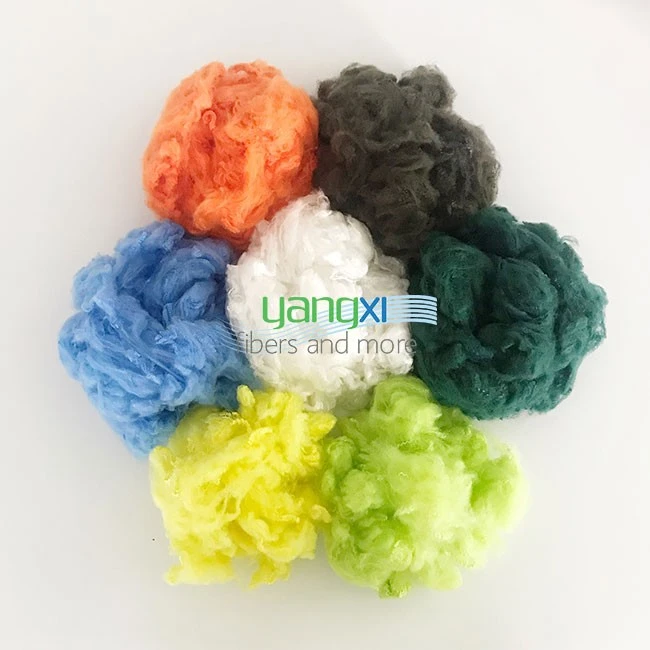

Heat resistance is another critical characteristic, especially for under-hood and dashboard parts. Under-hood parts can reach temperatures of up to 150°C, and interior parts near the dashboard can hit 80°C from sun exposure. PSF needs to retain its strength and shape at these temperatures, which is why we test our products for glass transition temperature (Tg) and melting point. Our automotive-grade PSF has a melting point of around 250°C, which means it won’t melt or deform even under extreme under-hood conditions. This is a huge advantage over natural fibers like cotton or wool, which can shrink or burn at lower temperatures. I remember a client that used cotton-based non-wovens for a heat shield; within two years, the cotton had started to break down from constant heat, leading to increased engine noise. Switching to our PSF line solved that problem immediately.
Cost efficiency is the final, practical characteristic that makes PSF the go-to for automotive non-wovens. Compared to other fibers like polypropylene or natural fibers, PSF has a lower overall cost per part, even when you factor in production and testing. It’s easier to process, has higher uniformity, and the recycled versions are often priced competitively with virgin materials. This is why 60% of non-woven automotive parts use PSF, according to a 2024 report from Textile World. For small car manufacturers, every dollar saved on materials adds up to lower consumer prices, and for luxury brands, it means they can offer premium acoustic insulation without breaking the bank.
Now, here’s what separates us from other PSF suppliers: we don’t just sell fiber—we work with our clients to tailor the characteristics to their specific part needs. If a client needs a soft, lightweight PSF for a headliner, we’ll adjust the crimp level to be lower and the denier to be finer. If they need a dense, heat-resistant fiber for an under-hood heat shield, we’ll crank up the denier and optimize the crimp to lock the fibers together tightly. We also offer both virgin and recycled options, so clients can choose what fits their sustainability goals and budget.
If you’re a non-woven manufacturer or an automaker looking to upgrade your automotive parts, or you need a reliable PSF supplier that understands the unique demands of the industry, get in touch to discuss your project. We can help you find the right PSF characteristics for your specific part, whether it’s acoustic insulation, a door panel insert, or floor mats, and deliver products that meet your performance, cost, and sustainability targets.
References
- European Automotive Manufacturers Association. (2023). Sustainable Materials in Automotive Non-Wovens: Performance and Impact. Brussels: EAMA Publications.
- Textile World. (2024). Global Trends in Polyester Staple Fiber for Automotive Non-Wovens. New York: Business of Textiles Media.
- International Organization for Standardization. (2021). ISO 105-X02: Textiles – Tests for Colour Fastness – Part X02: Colour Fastness to Artificial Light: Xenon Arc Fading Lamp Test. Geneva: ISO.
- Automotive News Europe. (2022). EU’s 2025 Recycled Content Rule: What It Means for Car Makers. Detroit: Crain Communications.
- Society of Automotive Engineers. (2020). SAE J1516: Thermal Stability of Textile Materials for Automotive Applications. Warrendale: SAE International.