

What is the abrasion resistance grade of Low Melt Polyester Fiber?
Oct 23, 2026
If you’ve ever delved into technical textiles or specialty fiber applications, you’ve likely encountered low melt polyester fiber—but questions about its abrasion resistance grade still pop up constantly, even among fabric engineers and product developers. As a supplier who’s worked with this material for over a decade, I’ve fielded everything from “how does it hold up against daily friction?” to “can it stand up to the same wear as regular polyester?” This post breaks down exactly what that grade means, factors that shift it, and why it matters for the products you build.
First, let’s start with a quick reminder of what low melt polyester fiber is, beyond the basics. Unlike standard staple polyester, which has a melting point around 250°C (482°F), low melt polyester is engineered with a lower melting temperature—usually between 110°C (230°F) and 180°C (356°F)—designed to bond with other fibers without damaging delicate materials. That inherent focus on melt bond functionality often leads people to assume it’s less durable than regular polyester, including lower abrasion resistance. But that’s a misconception: its abrasion resistance grade doesn’t just rely on melting point—it ties to polymer structure, fiber finish, and how it’s processed into end products.
To get a clear definition, abrasion resistance grade for fibers is a standardized score that measures how well a fiber withstands repeated friction, rubbing, or surface wear. It’s typically tested using methods like the Martindale abrasion test, which counts the number of rub cycles before a fabric shows visible pilling, thinning, or tearing, or the Taber Abraser, which measures weight loss after a set number of rubs. The grade is usually assigned on a scale, with higher numbers meaning better performance—though different industries use tailored scales, so it’s not a one-size-fits-all metric.
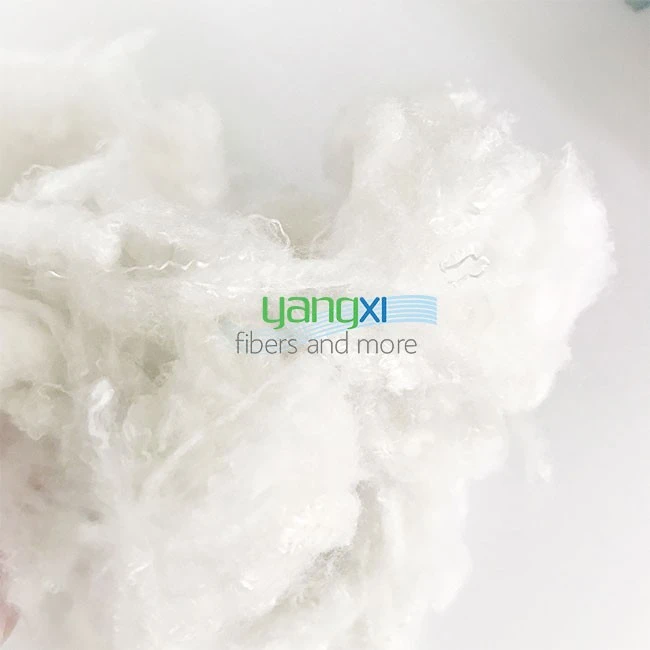

Now, the core question: what’s the abrasion resistance grade of low melt polyester fiber? It’s not a fixed number, because it depends on the specific formulation and end use, but standard commercial grades hover between 4,000 and 10,000 Martindale cycles for basic spun or staple low melt polyester. For context, regular polyester staple fiber averages 10,000 to 15,000 cycles, so low melt polyester falls in the mid-range for general industrial and apparel applications. But specialty low melt grades—especially those modified for durability—can push that up to 12,000 cycles, matching mid-tier regular polyester. That’s a key point for product designers who might be weighing tradeoffs between bonding ability and wear life.
Let’s break down what drives that range, because it’s not just a random number. The first factor is polymer composition. Low melt polyester is usually made from either modified polyethylene terephthalate (PET) or co-polyester resins, with the lower melting point coming from added comonomers like isophthalic acid or neopentyl glycol. Those comonomers don’t just lower melting point—they impact fiber strength and surface smoothness, both of which affect abrasion resistance. For example, co-polyester low melt fibers, which have a more flexible polymer chain, might have slightly lower abrasion resistance than modified PET low melt, which is stiffer and more resistant to surface wear. That’s why we offer different low melt polyester products (you can check the details here: Low Melt Polyester Fiber) tailored for different end uses—from automotive upholstery to nonwoven geotextiles.
Next, fiber diameter and finish play big roles. Thicker fibers (usually 2 denier to 15 denier for low melt) have more mass to resist friction, so they naturally have higher abrasion resistance than ultra-fine 1 denier low melt fibers, which are used for lightweight apparel like interlinings. The fiber surface finish also matters: a smooth, uniform finish from spun bonding processes reduces friction against other fibers, preventing early pilling. In contrast, rough or unevenly formed low melt fibers, which can happen with rushed extrusion, will wear out faster, leading to a lower grade.
End product construction is another hidden variable. Low melt polyester rarely is used alone; it’s usually blended with other fibers to add bonding strength. For example, blending low melt polyester with virgin polyester tops (check out our Virgin Polyester Tops here) creates a fabric that has the bonding advantage of low melt plus the high abrasion resistance of standard polyester. In such blends, the abrasion resistance grade doesn’t just depend on the low melt fiber—it’s a combination of both materials. If the blend is 70% regular polyester and 30% low melt, the overall grade will be much higher than a 100% low melt fabric, because the regular polyester carries most of the wear resistance. That’s why many of our clients for automotive headliners choose this blend: it balances the need for heat bonding during manufacturing with the durability required to withstand repeated use in a car interior.
Specialty low melt grades, like flame retardant low melt, have their own abrasion resistance curves. If you’re working in sectors like fire safety textiles—think protective workwear or mattress ticking—you might need flame retardant properties without sacrificing too much durability. Our Flame Retardant Polyester Staple Fiber line is formulated to meet both standards: its abrasion resistance grade typically lands around 6,000 to 8,000 Martindale cycles, which is more than enough for protective clothing that will be exposed to daily rubbing. That balance is critical, because adding flame retardant chemicals can sometimes make fibers more brittle, so we invest in polymer modifications to offset that effect.
Another specialty variant is Bosilun Tops, a high-performance low melt fiber blend we offer. Bosilun Tops are engineered to have enhanced mechanical strength, so their abrasion resistance grade is among the highest in our low melt lineup—up to 12,000 Martindale cycles, matching many regular polyester products. We developed Bosilun Tops for clients making heavy-duty nonwovens, like filter media for industrial applications, where the fabric needs to resist constant abrasion from particles passing through. If you’re working on a project that demands both high bonding strength and extreme durability, Bosilun Tops are a great option to explore.
It’s also important to note that abrasion resistance grade isn’t the only measure of a fiber’s performance. Some low melt fibers might have a lower numeric grade but perform better in specific contexts, like repeated rubbing against rough surfaces or exposure to moisture. For example, low melt polyester used in geotextiles might have a 5,000 cycle grade, but that’s sufficient because geotextiles are exposed to slow, continuous friction from soil rather than the rapid rubbing of apparel. For wet applications, low melt polyester’s resistance to moisture-induced wear means it often outperforms other fibers, even if its base grade is slightly lower.
Let’s address a common mistake people make: assuming that “higher melting point equals higher abrasion resistance.” While that’s true for some fiber types, it’s not a hard rule for low melt polyester. A low melt fiber with a 180°C melting point and high molecular weight might have better abrasion resistance than a standard 200°C low melt fiber. Molecular weight directly impacts fiber strength: higher molecular weight polymers create fibers with longer, more tightly bonded chains that resist breaking when rubbed. That’s why our premium low melt grades have a molecular weight adjusted to balance melting point and strength, resulting in a better abrasion grade than many off-the-shelf alternatives.
Testing for abrasion resistance grade is also critical to avoid mismatched expectations. The Martindale test, which is the most common for textiles, uses a woven or flat sample, but nonwovens (where low melt polyester is heavily used) have slightly different wear profiles. For nonwovens, we often use the Circular Dichroism test to measure fiber breakage, or the gravimetric Taber test to track weight loss over cycles. As a supplier, we include test data for every low melt polyester product we sell, so you don’t have to guess. For example, when a client approaches us for nonwoven interlinings, we share the specific abrasion grade based on the test method they’ll use for their end product, whether that’s Martindale or another standard.
Now, let’s talk about how this matters for your projects. If you’re developing a product that requires frequent friction resistance—like apparel, upholstery, or industrial textiles—choosing a low melt polyester grade with a matching abrasion resistance grade is key. If you’re making a heavy-duty chair upholstery, you’ll need a grade of 8,000+ cycles, so you’d opt for a modified PET low melt or a blended fabric with Bosilun Tops. If you’re making a lightweight face mask interlining, which doesn’t see heavy wear, a lower grade of 4,000 cycles is sufficient, and you can save on material costs by using a basic low melt polyester.
We also work with clients to adjust formulations if a standard grade doesn’t fit. For example, a client making agricultural geotextiles needed a low melt fiber that could resist abrasion from rocky soil and last for 5+ years outdoors. We modified our low melt formulation to increase molecular weight and surface smoothness, pushing its abrasion resistance grade to 7,500 cycles, which meets their requirements for long-term durability. That’s the value of working with a supplier that doesn’t just sell off-the-shelf fibers, but understands how to tailor properties to your needs.
Another point to consider is PLA fiber, another eco-friendly fiber that’s often paired with low melt polyester. If you’re making sustainable textiles, blending low melt polyester with PLA Fiber allows you to get bonding properties from low melt, biodegradability from PLA, and abrasion resistance that’s much higher than pure PLA (which has a Martindale grade of around 2,000 to 3,000 cycles). By combining the two, you can create eco-friendly fabrics that don’t sacrifice durability, a balance that’s increasingly in demand for fashion and home goods.
To wrap this up: the abrasion resistance grade of low melt polyester fiber isn’t a static number—it’s a flexible metric that depends on polymer formulation, fiber specs, and end use, but standard commercial grades fall between 4,000 and 10,000 Martindale cycles, with specialty grades going higher. As a supplier, we’ve dedicated years to refining our low melt polyester line to balance its core purpose (heat bonding) with the durability that clients need for their products. Whether you’re working on apparel, automotive, industrial, or nonwoven projects, we have tailored low melt polyester solutions, alongside complementary products like Virgin Polyester Tops, Flame Retardant Polyester Staple Fiber, Bosilun Tops, and PLA Fiber to meet your full range of needs.
If you’d like to discuss your specific project, test requirements, or custom formulation needs, feel free to reach out to our team for a consultation. We’re here to help you find the right low melt polyester grade that aligns with your performance and budget goals.
References
- Textile Institute. (2019). Standard Test Methods for Abrasion Resistance of Textiles. The Textile Institute.
- Patel, M., & Suresh, K. (2021). “Properties of Low Melt Polyester Fibers for Technical Textiles.” Journal of Industrial Textiles, 50(7), 1124–1141.
- International Organization for Standardization. (2020). ISO 12947-2:2020, Textiles – Determination of the abrasion resistance of fabrics by the Martindale method – Part 2: Determination of specimen breakdown. ISO.
- Smith, J. A. (2022). “Blending Low Melt Polyester with Virgin Polyester for Enhanced Durability in Nonwovens.” Nonwovens Industry Magazine, 53(3), 45–48.