

What is the fineness of RPET staple fiber?
Nov 21, 2026
If you've ever shopped for textiles, you've probably heard of RPET—Recycled Polyethylene Terephthalate—an eco-friendly material made by breaking down post-consumer plastic bottles into small plastic chips, then spinning those chips into usable fibers. As a supplier of RPET staple fiber, one of the questions I get asked most often by spinners, textile manufacturers, and even small business owners looking to launch sustainable products is: "What is the fineness of RPET staple fiber?" It's not a one-size-fits-all answer, and understanding fineness isn't just a technical detail—it's the difference between spinning a soft, comfortable yarn for T-shirts and a sturdy, durable fiber for carpets. Let's break down what fineness actually means for RPET staple fiber, why it matters, and how to choose the right fineness for your project.
First, let's get clear on the definition of fineness in the context of staple fibers, because it's not the same as how we talk about the fineness of a thread or fabric. Staple fibers are short, discrete fibers (usually 38mm to 150mm long, depending on the use) that are twisted together to make yarn. Fineness here refers to the linear density of the fiber—how much mass is packed into a given length. The most common units for measuring this in the textile industry are denier and tex, and sometimes decitex (dtex). Denier is the old-school standard most widely used in the U.S.: it's the mass in grams of 9,000 meters of fiber. For example, a 1 denier fiber is 1 gram per 9,000 meters. Tex is the metric equivalent: grams per 1,000 meters, so 1 tex is heavier than 1 denier (since 9,000 meters of 1 tex would be 9 grams). Most RPET staple fiber I supply is measured in denier, so that's what I'll focus on here, though it's easy to convert if you work with metric units.
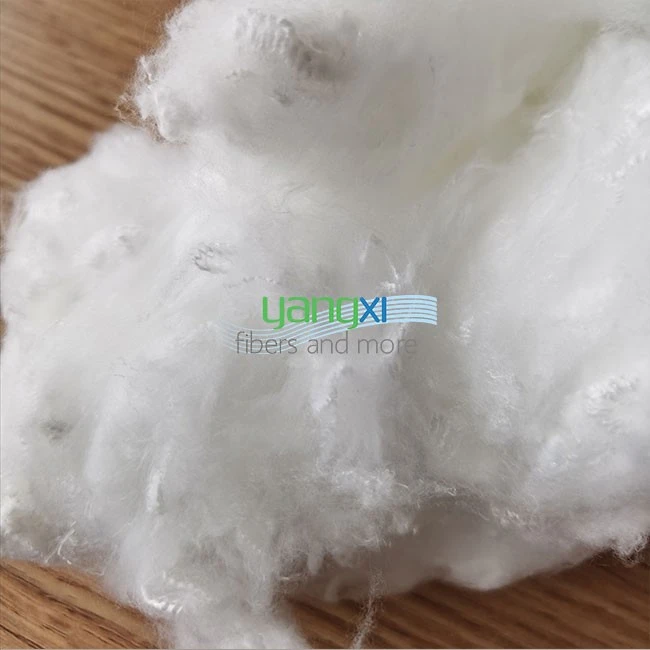
So, what's the typical range of fineness for RPET staple fiber? It spans roughly from 1.2 denier all the way up to 15 denier, but that range breaks down into distinct categories based on end use, and there's good reason for that variation. Let's start with the finest end of the spectrum: 1.2 denier to 3 denier. These are micro-fine fibers, and they're designed for soft, next-to-skin applications. Think about T-shirts, loungewear, bed linens, or even high-end face masks. These fine fibers feel almost like natural cotton, with a smooth, delicate hand (that's textile talk for how a fabric feels when you touch it). When you twist fine RPET staple fibers together, they create a yarn that's breathable, doesn't scratch, and holds dye really well—something that's important for apparel brands that want vibrant, long-lasting colors without harsh chemicals. For reference, our Raw White Polyester Staple Fiber in the 1.5 denier range is one of our bestsellers for apparel makers because it blends perfectly with cotton, modal, or even natural wool, giving a sustainable twist to fabrics that would traditionally use virgin fibers. You can check that product out here: Raw White Polyester Staple Fiber.
In the middle range, we have 3 denier to 8 denier. This is the most versatile fineness for RPET staple fiber, used in a huge variety of products beyond apparel. Let's break that down: 3 to 5 denier works for things like socks, underwear, and lightweight outerwear. They're slightly sturdier than micro-fines, so they hold up to more wear and tear, but still soft enough for clothing that's worn close to the body. The 5 to 8 denier range is where you'll find fibers for heavier apparel, like denim, work shirts, or upholstery fabric. These fibers are thicker, so the yarn they make is stronger, more resistant to pilling, and durable enough for everyday use. I often recommend this range to manufacturers making performance wear too, because the slightly thicker fiber wicks moisture better than micro-fines without sacrificing softness. If you're looking for a middle-ground RPET fiber that works for multiple applications, our Recycled Polyester Staple Fiber For Yarn Spinning in the 6 denier range is a great option, and it's GRS certified, which is a big plus for brands marketing their sustainability credentials. The GRS (Global Recycled Standard) is the leading certification for recycled materials, so it's no surprise that most quality RPET staple fiber suppliers offer GRS-certified products. You can learn more about our GRS Certified Recycled Polyester Staple Fiber here: GRS Certified Recycled Polyester Staple Fiber.
At the thicker end of the spectrum, 8 denier to 15 denier, these are heavy-duty fibers for products that need to be tough and long-lasting. Think carpets, rugs, upholstery for furniture that gets heavy use, geotextiles (the fabric used for erosion control and road construction), and even tote bags or luggage. These fibers are stiffer, stronger, and more resistant to abrasion than fine fibers, which is exactly what you need for a carpet that gets walked on every day or a rug that holds up to furniture legs. The 10 to 15 denier range is especially popular for commercial carpets, because they resist crushing and keep their shape for years. I've worked with several construction companies that use our GRS Polyester Fiber in the 12 denier range for geotextiles, since it's durable, UV-resistant, and 100% made from post-consumer plastic bottles. That product is available here: GRS Polyester Fiber.
Now, why does fineness matter beyond just the end product? There are a few practical reasons, starting with spinnability. If you're trying to spin a yarn for apparel, you can't use a 15 denier fiber—it would be too thick, the yarn would be scratchy, and it would be hard to twist into a smooth, even yarn. On the flip side, if you're trying to spin a yarn for a carpet, a 1.5 denier fiber would be too weak, it would break easily during spinning, and the finished carpet would wear out quickly. Fineness also affects yarn count: finer fibers spun together give a higher yarn count (thinner yarn), while thicker fibers give a lower yarn count (thicker, heavier yarn). That's why you'll see apparel yarns labeled with counts like 40/2 or 50/2, while carpet yarns might be labeled with counts like 10/1 or 12/1.
Another big factor is cost, which is a concern for almost every manufacturer. Finer RPET staple fibers require more processing to make, because the plastic chips have to be extruded into thinner, more uniform fibers, so they tend to be a bit more expensive per kilogram than thicker fibers. That's important to keep in mind if you're balancing sustainability goals with budget. Our Eco-friendly Polyester Staple Fiber line has options across every fineness range, so whether you need a budget-friendly 8 denier for carpet or a premium 1.5 denier for high-end loungewear, we've got you covered. You can explore the full range here: Eco-friendly Polyester Staple Fiber.
I should also note that fineness isn't the only technical factor that matters for RPET staple fiber, but it's one of the first things you need to get right. Things like length, crimp (the wavy pattern in staple fibers that helps them twist together), and tenacity (how strong the fiber is) are also important, but fineness is the foundation. For example, two fibers with the same denier can have different crimp levels, which will change how they spin and how soft the finished fabric feels. But if you start with the wrong fineness, no amount of crimp adjustment will fix a yarn that's too scratchy or too weak.
A common misconception I run into is that "finer" means "better." That's not true at all. A 1.5 denier fiber isn't a better RPET fiber than a 10 denier fiber—it's just better for different things. If you need a soft T-shirt, fine is perfect. If you need a carpet, thick is better. That's why my job as a supplier isn't just to sell RPET staple fiber—it's to help customers figure out which fineness is right for their specific project. I've had brands come to me asking for a fiber for a new line of eco-friendly socks, thinking they need the finest fiber possible, only to learn that a 4 denier fiber will give them the durability they need for socks, at a lower cost than a 1.5 denier. Conversely, I've had textile makers making high-end bed sheets that tried a 4 denier fiber and found it too rough, so we switched them to 2 denier, and they were thrilled with the result.
It's also worth mentioning that GRS certification applies across all fineness ranges, so if you need a sustainable product that's verified to use recycled materials, you don't have to compromise on fineness. Whether you need 1.5 denier for apparel or 12 denier for industrial use, our GRS Certified Recycled Polyester Staple Fiber is fully compliant with GRS standards, including traceability, third-party auditing, and restrictions on harmful chemicals. That's a huge selling point for brands that have to prove their sustainability claims to customers or retailers.
So, to circle back to the original question: What is the fineness of RPET staple fiber? The answer is, it depends on what you're making. It ranges from 1.2 denier for soft apparel and bedding up to 15 denier for heavy-duty industrial and commercial products, with the most popular middle range being 3 to 8 denier for socks, underwear, light outerwear, and upholstery. The key is matching the fineness to your end product, your spinning process, and your budget.
If you're in the market for RPET staple fiber and you're not sure which fineness is right for your project, or if you just have questions about the technical specs, feel free to reach out to our team for a consultation. We work with spinners, textile manufacturers, and brand owners around the world, and we're happy to help you find the perfect fiber for your needs, no matter what you're making.
References
- Global Recycled Standard (GRS) v4.0 Requirements. Textile Exchange, 2021.
- Textile Terms and Definitions, 12th Edition. American Association of Textile Chemists and Colorists (AATCC), 2017.
- Recycled Polyester Staple Fiber: Processing and Applications. Journal of Sustainable Textiles, vol. 8, no. 2, 2022, pp. 45-62.