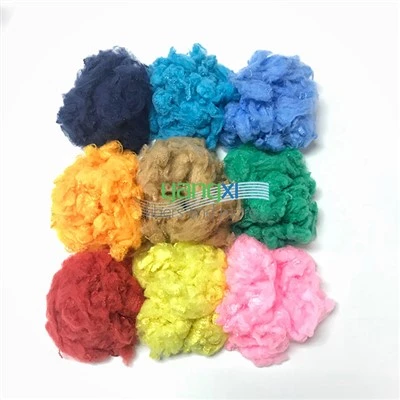

Analysis of the production methods of recycled polyester staple fibers
Aug 28, 2019
With the increasing global environmental awareness, recycled polyester staple fibers have become an important raw material in the textile industry due to their sustainability and economy.This article will introduce the main production methods of recycled polyester staple fibers to help foreign trade practitioners better understand the technological progress and market trends in this field.
The production of recycled polyester staple fibers usually uses waste polyester textiles, plastic bottles or other polyester waste as raw materials. First, these wastes are sorted, cleaned and crushed to remove impurities and non-polyester components to ensure the purity of the raw materials. The washed fragments are dried to reduce the moisture content and prepare for subsequent melt processing.
Next, the dried polyester fragments are fed into the extruder and melted into liquid polyester at high temperature. The molten polyester is filtered to remove residual impurities and ensure stable fiber quality. Subsequently, the liquid polyester is injected into the spinning box and formed into filaments through the spinneret under high pressure. These filaments form primary fibers after cooling, and then undergo processes such as stretching and curling to enhance their strength and elasticity, and finally cut into staple fibers of the required length.
In terms of production technology, the production technology of recycled polyester staple fibers is constantly being optimized. Some companies use chemical recycling technology to depolymerize waste polyester into monomers, and then repolymerize into high-quality polyester, thereby producing recycled fibers with performance close to that of virgin polyester. Although this method is costly, it can significantly improve the purity and performance of the fiber and meet the needs of high-end textiles.
From a market perspective, recycled polyester staple fibers are in great demand in the fields of clothing, home textiles and industrial textiles due to their environmentally friendly properties and cost advantages. If foreign trade companies can master their production technology characteristics and quality standards, it will be more conducive to opening up the international market. In the future, with the advancement of recycling technology and policy support, the market prospects for recycled polyester staple fibers will be broader.