
Appearance characteristics and application advantages of recycled polyester staple fiber
Jul 21, 2019
As an important raw material in the textile industry, recycled polyester staple fiber has attracted much attention in the foreign trade market in recent years due to its environmentally friendly properties and excellent performance. Its appearance characteristics directly affect the quality of subsequent processing and the effect of the finished product. Understanding its morphological characteristics is of great significance to buyers and manufacturers.
Appearance characteristics: both uniformity and functionality
The appearance of recycled polyester staple fiber is usually uniform cylindrical or dumbbell-shaped, and the fiber length can be divided into specifications such as 38mm, 51mm, and 64mm according to the purpose. The surface is smoother, and the cross-section is mostly circular or irregular (such as cross-shaped, Y-shaped) to meet the functional requirements of different fabrics. For example, irregular fibers can enhance the moisture absorption and perspiration or fluffiness of the fabric, while circular cross-section fibers are more suitable for clothing fabrics that pursue a soft touch.
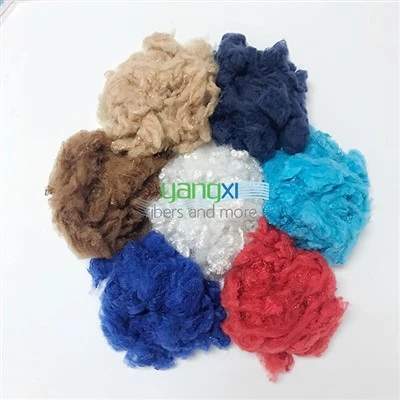
In terms of color, recycled polyester staple fiber can be stably colored by adding masterbatch, which is commonly available in natural white, black or customized colors, and the color uniformity is better than some natural fibers. In addition, the curl of the fiber directly affects the fluffiness and elasticity. High-curl fibers are often used for filling materials (such as pillows and sofas), while low-curl fibers are more suitable for clothing fabrics.
Application advantages: environmental protection and performance
The shape design of recycled polyester staple fiber not only meets the aesthetic needs, but also takes into account functionality. Its uniform length and fineness ensure stable tension during spinning and reduce the breakage rate; and the special-shaped cross-section design can improve the air permeability and wear resistance of the fabric, which is suitable for sportswear, home textiles and other products.
From an environmental perspective, recycled polyester staple fiber is made from waste plastic bottles or industrial waste. Its appearance is no different from that of virgin polyester, but its carbon footprint is significantly reduced. This feature makes it occupy an important position in the international textile market, especially in Europe and the United States, where environmental standards are strict.
As the global demand for sustainable materials grows, the shape technology innovation of recycled polyester staple fiber will continue to promote industry upgrading. When choosing, buyers can combine fiber shape parameters (such as length and curl) with specific uses to optimize supply chain efficiency.