
Managing Fabric Shrinkage Rates: A Technical Sourcing Evaluation of Dimensional Stability and Blending Solutions
Jun 18, 2026
In the volume apparel manufacturing and international textile trade sectors, maintaining the precise tailored dimensions of finished garments after repetitive commercial laundering is a vital metric governing product quality. One of the most persistent technical challenges encountered by sourcing managers is garment deformation caused by high fabric shrinkage rates. When unblended natural fibers or delicate cellulosics undergo standard wet processing, their internal polymer structures alter, causing garments to contract, lose their intended fit, and decrease their commercial shelf-life. Understanding the microstructural drivers behind fiber contraction and implementing strategic structural modifications is essential to secure predictable product dimensions for international retail markets.
Technical Classification of High-Shrinkage Substrates
The tendency of a textile to shrink depends directly on the moisture regain capacity of the raw fiber and the structural tension introduced during the spinning and weaving processes:
- Untreated Natural Cotton: Raw cotton fibers possess a highly absorbent cellulosic structure. When exposed to moisture, the cell walls swell laterally, which forces the lengthwise yarns to shorten. If the fabric has not undergone industrial preshrinking processes, standard cotton textiles can field a shrinkage rate between 3%-5%, causing standard basic apparel to lose its initial proportions after a single wash cycle.
- Animal Hair Fibers (Wool and Cashmere): These luxury animal proteins feature a distinct overlapping scale architecture on their outer surface. Under the combined influence of moisture, mechanical agitation, and temperature, these scales lock together permanently-a process known as felting. This structural locking can cause extreme dimensional loss, with shrinkage rates reaching 5%-10%, completely altering the garment size.
- Linen Substrates: Bast fibers are highly celebrated for summer breathability, but their rigid natural structure makes them highly susceptible to stress-relaxation shrinkage. Untreated flax linen routinely experiences shrinkage rates of 5%-8%, frequently accompanied by deep, permanent structural creasing that distorts the silhouette of the garment.
- Viscose (Regenerated Cellulose): Viscose rayon delivers exceptional silk-like softness and drape, but its amorphous internal structure absorbs immense volumes of water. This high absorption causes the wet fibers to become highly pliable and contract sharply upon drying, yielding high shrinkage rates between 4%-10% that complicate product development for close-fitting garments.
Industrial Risk Mitigation and Processing Controls
Preventing dimensional distortion requires a combination of targeted retail design choices and precise care instructions during laundering. At the manufacturing level, specifying fabrics that have undergone continuous mechanical pre-shrinking or chemical stabilization treatments lowers the probability of post-purchase contraction. During consumer maintenance, avoiding hot water and utilizing neutral, non-alkaline detergents protects delicate fibers from thermal shock. Furthermore, replacing high-heat commercial tumbling with flat air-drying preserves the original yarn spacing, preventing gravity and heat from permanently compressing the loop-and-weave topography.
Supply Chain Optimization: Controlling Shrinkage Through Engineered Blends
For international apparel networks balancing strict dimensional tolerance metrics with large-scale production budgets, the most effective method to control shrinkage is transitioning from pure commodities to engineered multi-fiber blends.
Integrating high-performance synthetics, such as a specialized blend of 65% cotton and 35% polyester, allows mills to utilize the rigid molecular memory of synthetic polymers to anchor the pliable natural fibers. This strategic blending configuration effectively limits the final fabric shrinkage to less than 0.5%, successfully delivering excellent close-contact skin comfort alongside superior structural longevity.
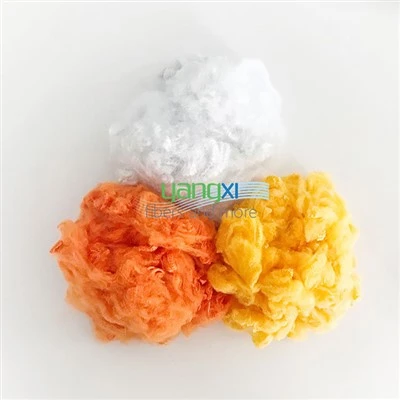
When manufacturing durable corporate uniforms, performance sportswear, or heavy-use home textiles that undergo continuous laundering, substituting traditional synthetic components with premium Recycled Polyester Staple Fiber allows weaving operations to stabilize final material performance. This option infuses the yarn matrix with excellent anti-wrinkle properties and dimensional memory derived from post-consumer circular polymers.
Concurrently, during the structural bonding and edge-finishing phases of tailored cuffs, collars, and waistbands, implementing advanced Low Melt thermal bonding fibers creates a hidden internal matrix that reinforces the primary seams. This technical integration prevents edges from curling or shrinking unevenly, allowing international garment manufacturers to avoid low-margin price wars, satisfy evolving global sustainability standards, and establish robust supply chain resilience in competitive retail marketplaces.