
Polyester-Cotton Blended Yarn Fabrics: Balancing Durability and Comfort
Sep 10, 2025
Polyester-cotton blended yarn fabrics have been a cornerstone of the textile industry since their development in the early 1960s in China. Adored by consumers globally, these fabrics masterfully blend the strengths of polyester and cotton-delivering a mix of longevity, comfort, and easy care. Let's explore what makes these fabrics so sought-after and how their dual-fiber makeup defines their performance.
Polyester Fiber Properties
As an advanced synthetic fiber, polyester comes with standout characteristics: it boasts high strength, a large modulus, low elongation, and exceptional dimensional stability. To the touch, it feels soft, has strong fiber cohesion, and offers a subtle sheen. While polyester's moisture absorption is quite low (with a moisture regain of only around 0.4% in typical air conditions-leading to a stuffy sensation in pure polyester garments), it excels in washability-polyester pieces dry rapidly and are famed for being "wash-and-wear." Moreover, polyester has a relatively high modulus (second only to linen fiber) and superb elasticity, which means fabrics using it stay wrinkle-resistant, dimensionally stable, and retain their shape well. Its abrasion resistance is top-tier (just behind nylon), though it's prone to pilling, and these pills don't fall off easily.
Cotton Fiber Properties
Cotton fibers have a unique structure: their cross-section is an irregular kidney shape with a central lumen, and lengthwise, they're tubular cells closed at one end-thicker in the middle and tapered at both ends-with natural crimps as a signature feature. Cotton resists alkalis but is sensitive to acids, and it has strong moisture absorption-under standard conditions, its moisture regain sits between 7% and 8%, and its wet strength is 10% to 15% higher than its dry strength. Exposing cotton to 100°C for 8 hours doesn't damage its strength, while it decomposes at 150°C and ignites at 320°C. Additionally, cotton has a low specific resistance, so it rarely builds up static during processing or wear.
Advantages of Polyester-Cotton Blending
By combining polyester and cotton, these fabrics capture the best of both fibers. They offer solid elasticity and abrasion resistance in both dry and wet states, with stable dimensions and minimal shrinkage. The result? Fabrics that are crisp, wrinkle-resistant, easy to wash, and quick to dry. They also have a bright luster, a smooth yet crisp hand feel, some elasticity, and fold marks from hand contact fade fast. While they do inherit a common synthetic fiber issue-pilling at areas of friction-polyester-cotton blended fabrics feel thick and soft, are comfy to wear, keep their shape after washing, and don't wrinkle or shrink.
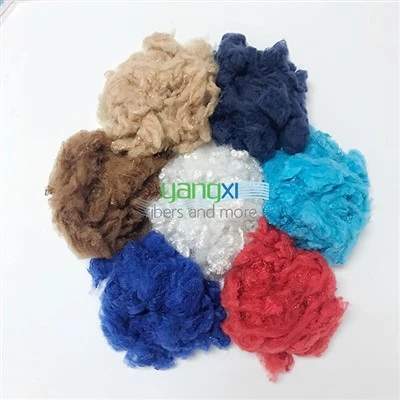
For businesses working on polyester-cotton blended textiles-whether for everyday apparel, workwear, or home linens-finding the right polyester fiber to complement cotton is key. Our polyester fibers (both filament and staple variants) are tailored to pair seamlessly with cotton: they maintain the "wash-and-wear" convenience and wrinkle resistance that make poly-cotton blends popular, while their soft texture balances cotton's natural comfort. We can also adjust fiber specifications to match different blend ratios (like 65/35 or 50/50) and end-use needs-whether you're prioritizing durability for work uniforms or softness for casual shirts. If you're looking to refine your poly-cotton fabric offerings, feel free to reach out for samples or custom solutions.
#PolyesterCottonBlend #TextileBlending #ApparelMaterials #PolyesterFiber #HomeTextileFabrics