

What are the anti - microbial agents for Low Melt Polyester Fiber?
Aug 15, 2026
As a supplier of Low Melt Polyester Fiber, I am often asked about the anti-microbial agents suitable for this type of fiber. Low Melt Polyester Fiber, known for its unique properties such as low melting point and good bonding ability, has a wide range of applications in industries like textiles, non-wovens, and bedding. Incorporating anti-microbial agents can enhance its performance and applicability, especially in areas where hygiene is crucial.
Importance of Anti-microbial Agents in Low Melt Polyester Fiber
In many applications, Low Melt Polyester Fiber comes into contact with the human body or environments where bacteria and fungi can thrive. For example, in the textile industry, fabrics made from this fiber are used in clothing and bedding. Anti-microbial agents can prevent the growth of odor-causing bacteria, mold, and mildew, which not only improves the comfort of the end-users but also increases the lifespan of the products. Additionally, in non-woven products used in medical and hygiene applications, anti-microbial properties are essential to prevent the spread of infections.
Common Anti-microbial Agents for Low Melt Polyester Fiber
Silver-based Agents
Silver has long been recognized for its anti-microbial properties. Silver-based anti-microbial agents work by releasing silver ions, which can inhibit the growth of a wide range of microorganisms. These agents can be incorporated into the fiber during the manufacturing process. For example, silver nanoparticles can be added to the polymer melt before spinning the Low Melt Polyester Fiber. Silver ions interact with the cell membranes of bacteria and fungi, disrupting their normal functions and leading to their death.
The advantage of silver-based agents is their broad-spectrum anti-microbial activity. They are effective against both Gram-positive and Gram-negative bacteria, as well as fungi. Moreover, silver has a relatively low toxicity to humans, making it a safe choice for applications where the fiber will come into direct contact with the skin. However, silver-based agents can be relatively expensive compared to other options, which may increase the production cost of the fiber.
Copper-based Agents
Copper is another metal with anti-microbial properties. Copper ions can penetrate the cell walls of microorganisms and interfere with their metabolic processes. Copper-based anti-microbial agents can be used in a similar way to silver-based agents, by adding them to the polymer matrix during fiber production.

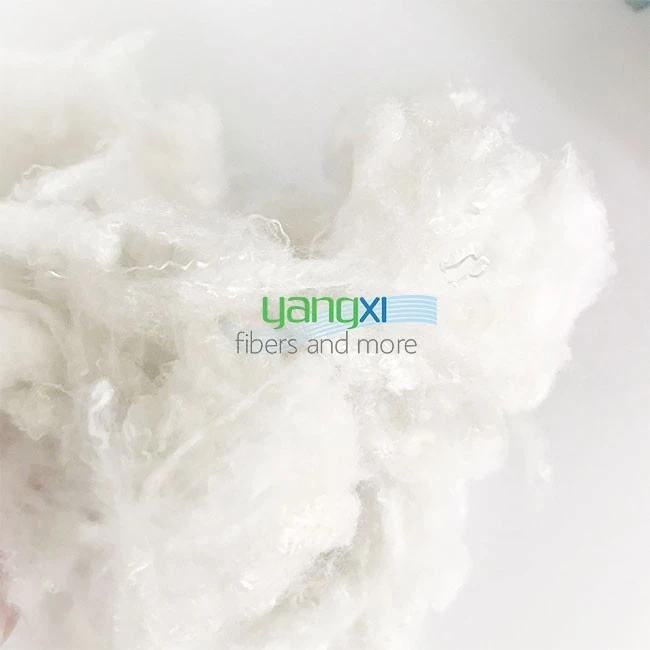
Copper is more abundant and less expensive than silver, which can be a significant advantage in large-scale production. It also has a long-lasting anti-microbial effect. However, copper may cause some discoloration of the fiber over time, which can be a drawback in applications where the appearance of the product is important.
Organic Anti-microbial Agents
There are also various organic compounds that can be used as anti-microbial agents for Low Melt Polyester Fiber. For example, triclosan is a well-known organic anti-microbial agent that has been widely used in the past. It can inhibit the growth of bacteria by interfering with their fatty acid synthesis.
Organic anti-microbial agents are often more cost-effective than metal-based agents. They can also be formulated to have different levels of anti-microbial activity and release rates. However, some organic anti-microbial agents may have environmental concerns, such as potential bioaccumulation and toxicity to aquatic organisms. Therefore, the choice of organic anti-microbial agents needs to be carefully evaluated based on the specific application and environmental requirements.
Incorporation Methods of Anti-microbial Agents
Melt Blending
Melt blending is one of the most common methods for incorporating anti-microbial agents into Low Melt Polyester Fiber. In this method, the anti-microbial agent is mixed with the polyester polymer in the molten state before spinning the fiber. The advantage of melt blending is that it ensures a uniform distribution of the anti-microbial agent throughout the fiber. However, the high temperature during the melt blending process may cause some degradation of the anti-microbial agent, which can reduce its effectiveness.
Surface Coating
Surface coating is another option for adding anti-microbial properties to the fiber. In this method, the anti-microbial agent is applied to the surface of the already spun fiber. This can be done through processes such as dipping, spraying, or padding. Surface coating allows for a more targeted application of the anti-microbial agent and can be used to apply agents that are not suitable for melt blending. However, the anti-microbial agent on the surface may be more easily washed off during laundering or use, which can reduce its long-term effectiveness.
Our Company's Approach
As a supplier of Low Melt Polyester Fiber, we are committed to providing high-quality products with enhanced anti-microbial properties. We work closely with our research and development team to select the most suitable anti-microbial agents and incorporation methods for our fibers.
We offer a range of Flame Retardant Polyester Staple Fiber, Bosilun Fiber, PLA Fiber, and Bosilun Tops in addition to our Low Melt Polyester Fiber. Our products are designed to meet the diverse needs of our customers in different industries. Whether you are in the textile, non-woven, or medical industry, we can provide you with customized solutions.
Contact Us for Procurement
If you are interested in our Low Melt Polyester Fiber with anti-microbial properties or any of our other products, we welcome you to contact us for procurement discussions. We have a team of experienced sales representatives who can provide you with detailed product information, samples, and competitive pricing. We look forward to establishing long-term partnerships with you and meeting your specific requirements.
References
- "Antimicrobial Textiles: A Review" by X. Wang et al.
- "The Use of Silver Nanoparticles in Textiles and Their Potential Impact on the Environment" by M. Benn et al.
- "Copper as an Antimicrobial Agent in Textiles" by J. Yoon et al.