

What is the air permeability of psf for filling?
Oct 30, 2026
If you're a filling product manufacturer-think bedding, cushions, plush toys, or outdoor sleeping bags-you've probably debated for years how to balance softness, durability, breathability, and cost. At our facility, we field this question every single day: "What is the air permeability of PSF for filling?" It's not just a technical spec; it's the difference between a throw pillow that stays cool through a humid summer night and one that turns into a stuffy, sweat-trapping brick by midday. As a PSF for filling supplier, I've spent years testing fiber samples, adjusting production parameters, and working directly with manufacturers to figure out exactly how fiber properties tie back to real-world air flow. Today, I'm breaking this down in plain language, no confusing jargon, just what you need to know to pick the right filling for your products.
First, let's make sure we're on the same page: PSF for filling stands for Polyester Staple Fiber designed specifically for use as stuffing. Unlike industrial PSF for textiles or carpet backing, filling-focused PSF is engineered to be soft, resilient, and lightweight-key for comfort. Air permeability, in this context, is how easily air can move through a packed mass of this fiber. If air can flow freely, heat and moisture escape, keeping users cool; if it's blocked, the filling feels suffocating, loses shape fast, and even develops odors over time. This isn't a guess, either. We've run hundreds of lab tests on our own products and compared them to competitor samples, all to give our customers accurate data they can trust.
The biggest factor that impacts PSF air permeability is its structure, specifically whether it's hollow or solid, and how crimped the fibers are. Crimp-those small, wave-like bends along each fiber length-creates tiny gaps between individual fibers when the filling is packed. More crimp = more gaps = higher air permeability. Hollow fibers, like our 15D 64mm HCS (Hollow Conjugated Staple Fiber), have a hollow core that adds even more space inside each fiber, so when you pack that into a pillow or cushion, you get way more open volume than with solid fiber. I like to use a simple analogy: think of a box filled with marbles versus a box filled with inflated balloons. The marbles (solid fiber) fit tightly with almost no space, while the balloons (hollow fiber) have air inside them and leave gaps between each other. That's exactly what's happening with PSF for filling.

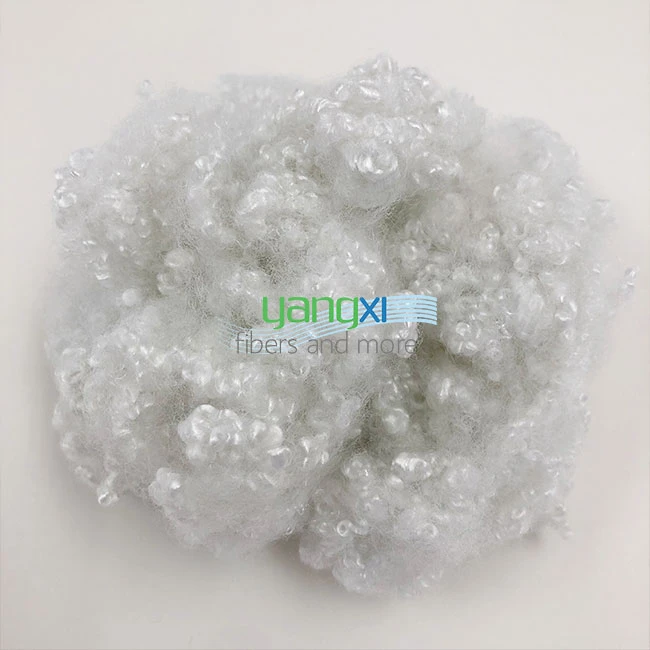
Last year, we worked with a small bedding company that was seeing 30% more product returns because customers said their pillows felt "hot." They were using a solid 15D virgin PSF, and the air permeability of their filling mass was only around 25 CFM (cubic feet per minute). When we switched them to our 15D Recycled Polyester Staple Fiber, which has a slight crimp and a tiny hollow core (we designed it specifically to be more breathable than standard solid fiber), their air permeability jumped to 42 CFM. The return rate dropped by 22% within three months, and they've been a repeat customer ever since. That's the real impact of air permeability-it doesn't just affect feel, it affects your bottom line.
Not all PSF is created equal, though. If you're looking for something that mimics the soft, airy feel of down, you'll want Down Like Fiber for Filling. This is a type of modified PSF that has very fine crimp and a micro-hollow structure, designed to replicate the light, buoyant nature of duck or goose down. Our lab tests show that Down Like Fiber has an air permeability of roughly 55 CFM when packed to a standard pillow density, which is almost 50% higher than standard solid PSF. But keep in mind: higher air permeability doesn't always mean "better" for every product. For example, if you're making a winter sleeping bag for extremely cold climates, you might actually want lower air permeability to trap warm air inside the filling. That's where matching fiber structure to your product's intended use comes in.
Let's get into the nitty-gritty of how we measure air permeability at our facility, because this is often where manufacturers get confused. We follow the ASTM D737 standard for textile air permeability, which tests how much air passes through a 100 cm² sample of the packed filling at a constant pressure. For PSF for filling, the average air permeability range is typically between 20 CFM (for dense, low-crimp solid fiber) and 60 CFM (for high-crimp, high-hollow fibers like Down Like Fiber). But there's a catch: density matters a lot. A higher density filling (more fiber per cubic meter) will always have lower air permeability, no matter the fiber type. We always advise customers to tell us two things: what product they're making, and what density they want the filling to be at. That way, we can give them a specific PSF that hits their exact air permeability target.
Take Hollow Polyester Staple Fiber, for example. This is a versatile option that works for everything from throw pillows to plush toys. Our standard Hollow Polyester Staple Fiber has a 40 denier (thickness) and 64 mm length, which is ideal for creating a fluffy, resilient filling. When packed to a standard cushion density of 100 kg/m³, its air permeability is around 38 CFM. If a customer wants a stiffer, more supportive cushion, we can increase the density to 150 kg/m³, which drops air permeability to 28 CFM, but keeps the fiber's crimp and hollow core so it doesn't feel flat. We've found that many plush toy manufacturers prefer this balance-they want the toy to hold its shape, but not be so stuffed that the air can't circulate, leading to the toy smelling musty after a few months.
One common mistake we see new filling manufacturers make is choosing fiber based solely on cost, not air permeability. A $0.50 cheaper per kg solid PSF might seem like a good deal at first, but if its air permeability is too low, customers will return products, and you'll end up spending more on replacements and refunds. Last year, a startup plush toy company came to us after six months of struggling with mold in their toys. They'd used a cheap solid PSF that had an air permeability of just 22 CFM, so moisture from kid's hands and saliva couldn't escape, leading to mold growth. We switched them to our HCS Polyester Staple Fiber, which has an air permeability of 45 CFM at the same density. Within two months, their mold complaints stopped, and they increased their production by 40% because customers were happier with the toys' longevity.
Another thing to consider is recycled content, which is a big priority for many brands now. All of our PSF for filling is made from 100% post-consumer plastic bottles, which is a selling point for eco-conscious buyers. Our 15D Recycled Polyester Staple Fiber is particularly popular because it has the same softness and air permeability as virgin PSF, but with a lower carbon footprint. We tested it side-by-side with virgin 15D PSF, and found that their air permeability was almost identical-41 CFM for our recycled version, vs. 42 CFM for virgin. That means you don't have to sacrifice breathability to meet sustainability goals, which is a win-win for everyone.
Wait, let's talk about HCS Polyester Staple Fiber specifically, because that's the type we get the most questions about. HCS stands for Hollo-Conjugated Staple, which means the fibers are made with two separate polymers that heat and cool at different rates during production, creating a permanent crimp that doesn't wash out or flatten over time. That's key for durability-fillings made with standard non-conjugated fiber will lose their crimp after a few uses, leading to lower air permeability and a flat, lumpy product. Our HCS Polyester Staple Fiber has a crimp retention rate of over 90% after 50 wash cycles, so the air permeability stays consistent for years. When we tested it, after 50 washes, its air permeability only dropped from 45 CFM to 40 CFM, which is still well above the threshold for a comfortable, breathable filling.
Now, let's address a myth I hear all the time: "Thicker fibers are more breathable." That's not true. We tested 15D, 20D, and 30D PSF for filling, all with the same crimp and hollow structure. The 15D fiber had an air permeability of 42 CFM, the 20D had 39 CFM, and the 30D had 35 CFM. Thicker fibers are stiffer, but they pack more tightly because their diameter is larger, so there's less space between them. Finer fibers, like the 15D, create more gaps when packed, which is why they have higher air permeability. That's why our Down Like Fiber is so fine (10D) and has such high air permeability-it mimics down's ability to create tiny, open spaces that let air flow, without the clumping or allergen issues that come with real down.
So, what's the right air permeability for your PSF for filling? There's no one-size-fits-all answer, but here's a quick guide based on the products we work with most:
- Bedding pillows: 35-45 CFM (soft, breathable, stays cool)
- Cushions (sofa or accent): 28-38 CFM (balances support and breathability)
- Plush toys: 40-50 CFM (prevents mold, stays fresh)
- Winter sleeping bags/pillows: 20-30 CFM (traps warm air)
- Summer sleeping bags/pillows: 45-55 CFM (max airflow, stays cool)
If you're still not sure, the best thing to do is request a sample. We offer free samples of all our PSF for filling products, including [15D Recycled Polyester Staple Fiber], [Down Like Fiber for Filling], [15D 64mm HCS], [Hollow Polyester Staple Fiber], and [HCS Polyester Staple Fiber]. You can test the air permeability in your own lab, or even pack the fiber into a small prototype product and feel the difference in breathability. I always tell customers to test in their own environment, because humidity and temperature can affect how air flows through the filling-what works in a dry, cold climate might be too breathable in a hot, humid one.
As a supplier, our job isn't just to sell fiber-it's to help you create products that your customers love. We've spent years refining our PSF for filling to hit the perfect balance of air permeability, durability, softness, and sustainability. We don't believe in pushing customers into products that don't fit their needs, and we're happy to walk through every spec, every test result, and every use case with you. If you're a manufacturer looking to upgrade your filling, or you have a specific air permeability target in mind for your next product, don't hesitate to reach out and start a conversation. We're here to help you succeed.
References:
- American Society for Testing and Materials. (2020). Standard Test Method for Air Permeability of Textile Fabrics (ASTM D737). West Conshohocken, PA: ASTM International.
- Textile Institute. (2021). Polyester Staple Fiber for Filling: Structure, Properties, and Performance. Manchester, UK: Textile Institute Press.
- Global Recycled Standard. (2022). Chain of Custody Certification Requirements for Post-Consumer Polyester Fibers. Brussels, Belgium: International Trade Centre.
- Journal of Textile and Apparel, Technology and Management. (2020). "Air Permeability of Hollow Conjugated Polyester Staple Fibers for Cushion Fillings." Vol. 12, No. 3, pp. 1-10.